Wat zijn de beleidsscenario’s op basis van verschillende verkiezingsuitslagen in de VS? In dit artikel volgt een interessante infographic met bijbehorende uitleg in het Engels van Vincent Reinhart, hoofdeconoom van Standish, een boutique van BNY Mellon. Daarin legt hij uit wat de eventuele beleidsscenario’s van beide presidentskandidaten zijn op basis van verschillende mogelijke verkiezingsuitslagen.
Elections matter, especially when the choice offers distinct and unpredictable governing outcomes. Here, we consider four election outcomes following 8 November and how they might affect the US political, regulatory and economic landscape.
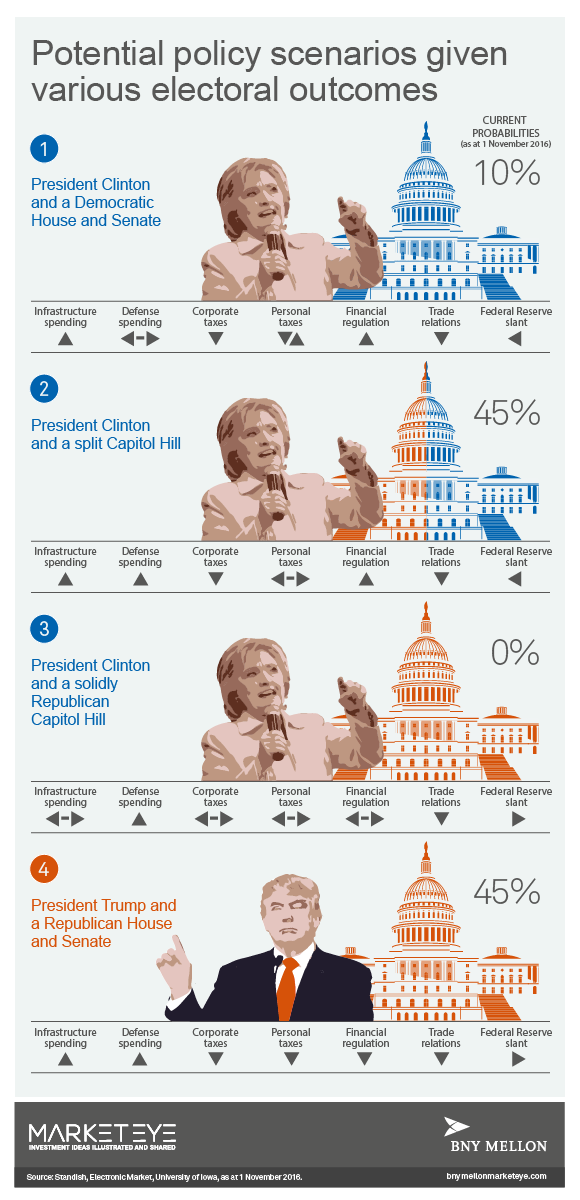
(1) President Clinton and a Democratic House and Senate
A uniformly Democratic Congress will probably reveal how quickly the gears of the government can mesh. The last time this happened, President Obama signed the American Recovery and Reinvestment Act the month after his inauguration in February 2009. Capitol Hill most likely tugs the White House left of the president’s more centrist leanings, a process that already began during the nomination contest.
(2) President Clinton and a split Capitol Hill
Given the advantage of incumbency, the most likely outcome is a divided government, where President Clinton has to work with a Republican House. An advantage is that she will have leverage that comes from a Senate run by a Democratic majority. Control of the Senate provides the president with some freedom in nominating appointees to her liking, but the voting margin there seems likely to be sufficiently slim that procedural manoeuvring will make some of those nomination battles dramatic. Expect progress on corporate tax reform, some spending on infrastructure, and a preservation of the regulatory infrastructure erected over the past eight years.
(3) President Clinton and a solidly Republican Capitol Hill
With Capitol Hill run by the opposition party, President Clinton will have to curb her party’s ambitions on appointees and compromise on legislation. Look to key appointees, whenever they are finally confirmed, to be well right of the Clinton campaign’s talking points. The major legislative initiatives of the White House may well be the exercise of veto power. Tighter gridlock than we have known before makes it likely that there will be no meaningful progress on tax reform nor an increase in infrastructure spending.
(4) President Trump and a Republican House and Senate
Under an all-Republican outcome, the same party controls the White House, the House of Representatives, and the Senate, but the president, speaker, and majority leader are not really on the same page about policy. The need to show progress will drive them to some compromises, picking the low-hanging fruit common to all involved.
Fiscal stimulus kicks in quickly, with more spending on defence and infrastructure and a restructuring of corporate taxes. After that, expect the slow crawl of tax reform, designed by the speaker to be acceptable to the president. Meanwhile, the White House will be using its executive authority to scale back the nation’s position in international trade.